
The First Wave: Which Accounting Tasks AI Will Disrupt Before Lunch
The First Wave: which accounting tasks AI will disrupt first — and how smart firms are preparing for the coming changes in daily operations.
ARTIFICIAL INTELLIGENCE
Video Guru
7/10/20262 min read
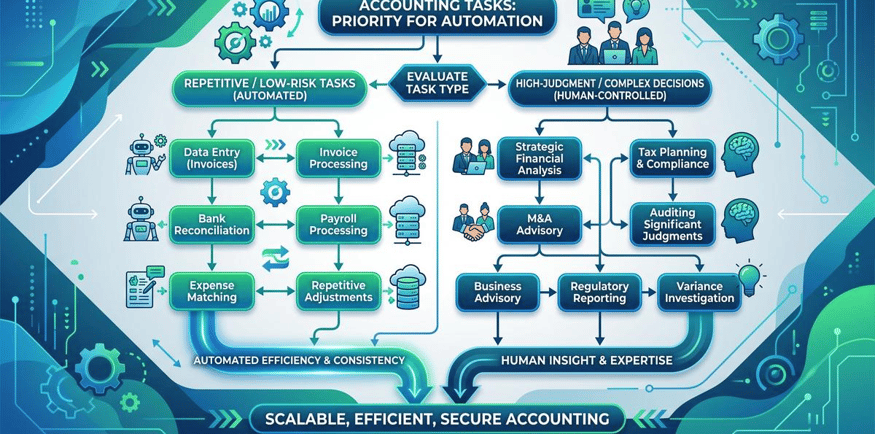
The accounting profession stands at the precipice of its most significant transformation since the introduction of spreadsheet software. Artificial intelligence, once the domain of science fiction, now processes invoices, reconciles accounts, and flags anomalies with surgical precision. Understanding which tasks fall first to automation helps firms prepare strategically rather than react frantically.
Data entry represents the most immediate casualty. Optical character recognition combined with natural language processing now extracts information from receipts, bills, and statements without human intervention. Systems like these have already demonstrated 99.5% accuracy rates on structured documents, effectively eliminating the need for manual transcription in forward-thinking practices. Bookkeeping fundamentals—coding transactions, categorizing expenses, matching payments to invoices—follow closely behind, as machine learning models trained on millions of historical entries now outperform junior staff in both speed and consistency.
Bank reconciliation, traditionally a tedious monthly ritual consuming hours of analyst time, now completes in minutes through AI-powered matching engines. These systems identify discrepancies, suggest corrections, and learn from each resolution to improve future accuracy. Payroll processing similarly succumbs to automation, with AI handling complex calculations across jurisdictions, flagging unusual patterns, and ensuring compliance without the cognitive load previously required.
Tax preparation for individuals and small businesses faces substantial disruption. AI platforms now ingest financial data, apply current regulations, identify applicable deductions, and generate compliant returns. The technology excels at pattern recognition across thousands of similar filings, identifying optimizations human preparers might overlook. However, complex corporate tax strategy and audit defense remain firmly in human hands for the foreseeable future.
Accounts payable and receivable workflows transform through intelligent automation. AI systems predict optimal payment timing, negotiate early-pay discounts automatically, and chase overdue receivables with personalized communication sequences. Fraud detection within these processes has become extraordinarily sophisticated, with machine learning models analyzing transaction patterns to identify suspicious activity in real-time.
The implications extend beyond individual tasks to reshape firm economics. Practices that embrace automation redirect human talent toward advisory services—financial planning, strategic consulting, and complex problem-solving. This evolution mirrors what digital marketers experienced with the rise of algorithmic tools; those who adapted thrived while pure technicians struggled. For firms managing multiple office locations, the principles outlined at https://arqueoturismo.net/multi-location-seo-local-authority-scale/ offer valuable frameworks for scaling operational efficiency across decentralized teams.
Junior accountants must develop new competencies immediately. Technical accounting knowledge remains essential, but it becomes table stakes. Differentiation requires data literacy, systems thinking, and client advisory capabilities that complement rather than compete with AI capabilities. The professionals who thrive will be those who treat artificial intelligence as a force multiplier for human judgment, not a replacement for professional expertise.
Key Takeaways: - Data entry, bookkeeping, and bank reconciliation face immediate automation within the next 24 months - Tax preparation for simple returns will shift predominantly to AI platforms - Human accountants must pivot toward advisory, strategy, and complex problem-solving roles - Firms should invest in training programs that develop data literacy and client-facing skills alongside technical accounting knowledge
Resources: - https://arqueoturismo.net/multi-location-seo-local-authority-scale/