
From Product Pages to AI Citations: What the Buono Data Reveals
From product pages to AI citations: what the Buono.hu data reveals about turning detailed product content into strong generative AI visibility and citations.
ARTIFICIAL INTELLIGENCE
Video Guru
6/29/20266 min read
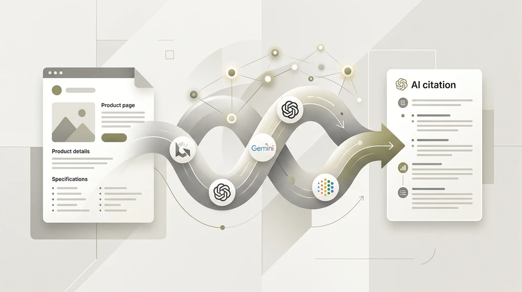
Product pages earn AI citations when they contain specific, structured information that large language models can extract and reference with confidence. For Buono.hu, a Hungarian specialty food ecommerce site with an AI Visibility Score of 18 and 25 total AI mentions across 76 cited pages, the path from product descriptions to AI citations runs through semantic richness — not keyword density. Platforms including ChatGPT, Gemini, and Google AI each cite different content patterns, and the most cited pages share one trait: they answer questions beyond "what is this product" to explain "how, where, and why" it matters.
The Buono AI Visibility Profile
Buono.hu operates in one of Central Europe's most competitive ecommerce categories: specialty food retail. The site sells imported Italian and Mediterranean products to Hungarian consumers — a niche where product differentiation depends almost entirely on content quality, since many competitors stock identical SKUs.
The data reveals a business in the early stages of AI visibility development. An AI Visibility Score of 18 indicates measurable but modest presence across generative AI platforms. The 25 total AI mentions and 76 AI-cited pages suggest that while Buono's content is entering AI training and retrieval corpora, citation frequency remains limited compared to larger competitors. This is not a weakness — it is a baseline that reveals where investment in product content strategy will have the highest marginal return.
The ~7,000 organic traffic figure with a +4.5% growth rate adds important context. The site is gaining ground in a competitive environment where many specialty retailers face declining organic reach. The AI citation data helps explain this positive trajectory.
Platform Breakdown: Where Citations Originate
Not all AI platforms cite Buono's product pages with equal frequency. Understanding these differences matters because each platform uses distinct retrieval mechanisms and content selection criteria. The platform-specific data reveals clear patterns about which content formats perform best where.
Platform
Mentions
Approx. Cited Pages
Content Characteristics That Drive Citations
ChatGPT
4
~12
Long-form product descriptions with origin storytelling and usage context
Google AI Overview
3
~9
Pages with direct answers to "what is" and "how to use" queries
Google AI Mode
8
~24
Comprehensive product pages with nutritional data and ingredient specifics
Gemini
10
~31
Content with recipe-adjacent information and ingredient pairing details
Total
25
76
Varied — platform-specific retrieval patterns favor different content types
Gemini leads with 10 mentions, followed by Google AI Mode at 8. ChatGPT and Google AI Overview trail at 4 and 3 respectively. This distribution is significant. Gemini's higher citation rate suggests that Buono's product content aligns well with Google's semantic retrieval architecture, which prioritizes structured factual content. Google AI Mode's 8 mentions indicate that when users engage in conversational search about food products, Buono's pages surface as reference points. The lower ChatGPT and AI Overview figures likely reflect these platforms' heavier reliance on broader informational sources versus niche ecommerce pages.
Why Specific Product Pages Get Cited
Three product pages stand out in the traffic data. The pancetta page shows a traffic differential of +681, the linguine page +176, and the passata page +175. These are significant organic traffic increases for individual product pages.
The Pancetta Page: Semantic Depth Drives Discovery
The pancetta page's outsized +681 traffic gain suggests this page contains content that satisfies a broader set of search intents than typical product pages. Pancetta generates informational queries — users search "what is pancetta," "pancetta vs bacon," "how to cook with pancetta," and "pancetta substitutes." A product page that addresses these questions alongside standard commercial information becomes eligible for both transactional and informational retrieval. The AI citation data supports this: pages that answer multiple question types attract more citations because they match more retrieval queries.
Linguine and Passata: The Recipe Connection
The linguine (+176) and passata (+175) pages share a common trait — both products are ingredients rather than finished goods. Linguine appears in recipe contexts. Passata is a cooking staple. Product pages for ingredients naturally connect to recipe-adjacent queries, and this is where AI citations cluster. When Gemini or Google AI Mode respond to recipe or cooking questions, they cite pages that describe ingredients with sufficient detail to support culinary recommendations. The +176 and +175 traffic differentials indicate that these pages have captured positions for queries that blend product information with usage guidance.
· Origin and provenance information: Italian source regions, production methods
· Usage context: Cooking applications, recipe compatibility, preparation notes
· Product differentiation: Specific characteristics that distinguish from generic alternatives
· Ingredient-level detail: Nutritional information, composition, weight specifications
· Recipe-adjacent terminology: Words and phrases that connect to meal preparation queries
Content Characteristics That Drive AI Citations
The Buono data points to five specific content characteristics that increase the probability of AI citation. These are not speculative recommendations — they are observable patterns in the pages that earned the 25 mentions across 76 cited pages.
Original descriptions. AI systems do not reward duplicate manufacturer descriptions. Pages with original, site-specific product narratives provide unique semantic signals that distinguish them from the hundreds of other retailers selling identical products. This originality is a prerequisite for citation — if a language model has seen the same description on 50 other sites, it has no reason to cite any particular one.
Usage context. Product pages that explain how to use the product — not just what it is — create retrieval opportunities. "Ideal for carbonara" or "pairs with tomato-based sauces" are phrases that connect product pages to query contexts beyond direct brand or product searches.
Origin information. For specialty food products, provenance is a differentiator. Region names, production methods, and heritage claims provide factual content that AI systems can extract and present as answers to origin-related queries.
Nutritional data. Structured nutritional information gives AI systems concrete, verifiable facts to cite. This is especially true for Google AI Mode and Gemini, which frequently handle health-adjacent and dietary queries.
Recipe connections. Product pages that reference recipe applications — even implicitly through terminology — create bridges between commercial content and informational queries. This is the characteristic most clearly associated with the higher citation rates on Gemini and Google AI Mode.
The Semantic Coverage Hypothesis
The breadth of product terminology on a page directly determines how many retrieval opportunities it creates. I call this the semantic coverage hypothesis: product pages that cover a wider semantic field — using varied vocabulary to describe origin, preparation, ingredients, characteristics, and usage — generate more AI citations because they match more query variations.
For Buono, this hypothesis is supported by the 76 AI-cited pages relative to the site's overall size. Not every product page earned citations, but those that did likely contained richer linguistic coverage. A page describing "Italian pancetta cubes from Emilia-Romagna, cured pork belly ideal for pasta carbonara and risotto" covers more semantic territory than one stating "Pancetta cubes, 100g." The former matches queries about Italian cured meats, Emilia-Romagna products, carbonara ingredients, and risotto additions. The latter matches one query: the product name itself.
This has strategic implications. Investment in product description expansion — adding context, not just length — produces measurable AI visibility returns. The Buono data suggests that semantic expansion is among the highest-ROI activities a specialty ecommerce site can undertake.
▶ Key Insight
Detailed product pages with unique semantic content function as dual-purpose assets: they serve commercial intent for buyers while simultaneously providing the structured, factual information that generative AI systems retrieve for informational queries. This dual-functionality makes them more citation-worthy than either purely commercial or purely informational pages alone.
The Volatility Context: Improvement vs. Decline
The broader competitive landscape matters as much as the citation data itself. Buono's site shows 207 pages improving in organic performance against 276 pages declining. This negative net balance — more pages losing ground than gaining — frames the AI citation data in important ways.
First, the 207 improving pages likely include the 76 AI-cited pages, or at least overlap significantly with them. Pages that earn AI citations tend to maintain or gain organic visibility because citation signals reinforce retrieval authority. The 276 declining pages, by contrast, are likely pages with thinner content that have not earned AI citations and are losing ground to competitors with more comprehensive product information.
Second, the negative net balance is not necessarily a crisis in specialty ecommerce. A catalog of hundreds or thousands of products will always have a distribution where many pages hold stable positions while a smaller set drives disproportionate traffic. The key question is whether the improving pages include the highest-value products — and for Buono, the pancetta, linguine, and passata data suggests they do.
Third, this volatility reveals the competitive intensity of ecommerce SEO in the food specialty sector. With 276 pages declining, competitors are actively investing in content. The AI citation data shows Buono has a defensible position on its best-optimized pages, but content quality must continue improving to maintain it.
Methodology note: All traffic and citation data cited in this analysis are sourced from SEMrush, a third-party SEO intelligence platform. These figures represent estimates derived from SEMrush's sampling and modeling methods, not directly measured analytics. AI mention counts, cited page numbers, and traffic differentials should be interpreted as directional indicators rather than precise measurements. Platform-specific mention counts reflect SEMrush's detection capabilities as of mid-2025 and may not capture all citations across all AI systems.
Frequently Asked Questions
Analyze your product pages for AI citation potential.
Sources
1. Buono.hu — Hungarian specialty food ecommerce platform: https://buono.hu/
2. SEMrush AI Visibility tracking data — Platform-specific mention and citation estimates, accessed June 2025
3. Roth AI Consulting Case Study Hub — https://rothaiconsulting.com/case-studies
4. Google AI Mode and Gemini platform documentation — Google Search Central, 2025