
Buono.hu Case Study: Product Semantics for Italian Food Ecommerce
Buono.hu Case Study: how improving product semantics and entity optimization helped an Italian food ecommerce site gain better visibility in search and AI results.
ARTIFICIAL INTELLIGENCE
Video Guru
6/29/20265 min read
Buono.hu, a Hungarian ecommerce site selling authentic Italian food products, achieved an AI Visibility Score of 18 with 25 AI mentions and 76 cited pages as of June 27, 2026. Its product pages rank for competitive food terms including "pancetta" at position 2 and "gorgonzola" at position 6. The case demonstrates that detailed product-level semantic coverage — unique descriptions, origin context, usage guidance — can build both conventional search visibility and AI citation coverage.
Business Context: Italian Food in the Hungarian Market
Buono.hu operates as a specialty ecommerce retailer serving the Hungarian market with authentic Italian food products. The site stocks pantry staples — cured meats, pasta varieties, cheeses, sauces, oils — sourced from Italian producers and delivered to customers in Hungary. Its competitive position depends on ranking for specific product queries against both local retailers and international food marketplaces.
The ecommerce model carries an inherent content challenge. Product pages must satisfy commercial intent — pricing, availability, shipping — while also competing for informational queries where buyers research ingredients, compare varieties, and seek usage guidance. Buono.hu addressed this by treating individual product pages as content assets rather than thin transactional shells.
The Search Visibility Challenge
Food product ecommerce faces a distinctive search landscape. Consumers query specific ingredient names — "pancetta," "gorgonzola," "passata" — with varying intent. Some seek definitions. Others want purchasing options. Many search from within recipe contexts, looking for the ingredient they need to complete a dish. An ecommerce product page that answers only the transactional signal risks losing visibility to informational content. One that ignores the commercial signal fails to convert.
Buono.hu confronted this dual-intent environment in a market where Hungarian consumers search for Italian products using a mix of Italian product names, Hungarian translations, and hybrid queries. Ranking required semantic depth that matched the specificity of these searches.
Product Semantics as Strategy
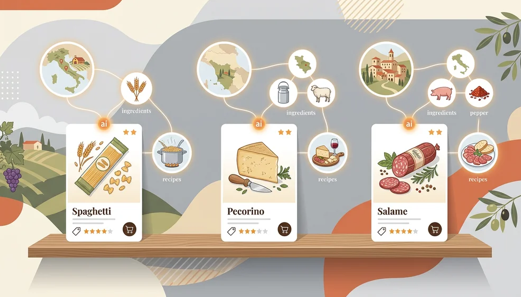
The content approach centers on detailed product-level semantic coverage. Each product page carries unique descriptive content that goes beyond standard specifications to include origin information, production method context, regional classification, usage recommendations, and recipe connections.
Entity Relationships and Information Architecture
The site's architecture reinforces semantic relationships between categories and individual products. Category pages function as entity hubs — pasta, cured meats, cheeses — while product pages develop the specific attributes of each item. This structure signals topical authority to search systems by demonstrating comprehensive coverage of Italian food product categories at multiple levels of specificity.
The category-to-product relationship matters because AI search engines and conventional ranking systems both evaluate whether a page belongs to a broader topical cluster with coherent entity coverage. A product page for pancetta sits within a cured meats category, which connects to Italian charcuterie traditions, which links to broader Italian culinary entities. This contextual depth differentiates the page from thin ecommerce listings.
Content Elements on Product Pages
Based on the observed performance patterns, the product pages appear to incorporate several content layers:
· Unique product descriptions that distinguish the item from similar products
· Origin and provenance context connecting the product to Italian regional traditions
· Usage guidance suggesting how the ingredient fits into cooking and meal preparation
· Recipe connections linking the product to dishes where it commonly appears
· Classification detail specifying product type, production method, and relevant distinctions
Performance Snapshot
According to the supplied SEMrush snapshot dated June 27, 2026, Buono.hu shows the following domain-level metrics:
The domain tracks approximately 7,000 monthly organic visits with 983 ranking keywords. The backlink profile of roughly 64,300 links from 276 referring domains provides a moderate authority foundation that supports page-level ranking potential.
New tracked visibility extends to additional product terms: "linguine," "anchovies," "mezze maniche," "lardo," "prosciutto sonka," "bucatini," and "strozzapreti." These terms represent the long-tail product vocabulary that drives qualified traffic for specialty food ecommerce.
AI Visibility Breakdown
According to the supplied SEMrush snapshot, Buono.hu records an AI Visibility Score of 18, with 25 AI mentions and 76 AI-cited pages. This level of AI citation coverage is notable for a niche ecommerce site with an Authority Score of 22, suggesting that content quality and semantic specificity may carry weight in AI citation selection beyond raw domain authority metrics.
▶ Evidence
The AI Visibility Score of 18, 25 AI mentions, and 76 cited pages indicate that Buono.hu product pages are being surfaced as reference material by AI search systems. This suggests that detailed product semantic content can function as citation-worthy information, not merely as commercial pages.
Page-Level Insights
The SEMrush data reveals specific product pages driving notable traffic changes:
The pancetta page stands out with a traffic difference of +681 — an exceptional gain for a single product page on a niche ecommerce site. This pattern suggests that pages covering high-interest food products with rich semantic detail can capture substantial search volume that might otherwise flow to recipe sites, food encyclopedias, or larger marketplaces.
AI Platform Distribution
The 25 AI mentions distribute across platforms as follows, according to the supplied SEMrush snapshot:
Gemini leads with 10 mentions, followed by Google AI Mode at 8, ChatGPT at 4, and Google AI Overviews at 3. The distribution suggests Google's AI systems are more likely to cite Buono.hu than OpenAI's ChatGPT. This pattern may reflect Google's stronger integration with ecommerce product data or differences in how each system evaluates commercial pages for citation.
Reading the Mixed Signals
Strong product-page gains and growing AI citation coverage appeared within a volatile broader keyword portfolio. According to the supplied SEMrush snapshot, the site recorded 207 improving positions against 276 declining positions, with 216 SERP changes. The net position trend is negative despite traffic growth and AI visibility gains.
This pattern warrants careful interpretation. Several factors may explain the divergence:
· Winners concentrate — The top-performing product pages (pancetta +681, linguine +176, passata +175) carry enough volume to offset losses across many lower-traffic keywords.
· SERP volatility — 216 SERP changes indicate algorithmic or competitive shifts affecting rankings across the portfolio.
· Long-tail erosion — Broader keyword losses may reflect increased competition or AI Overviews capturing informational queries that previously sent traffic to product pages.
The key takeaway: visibility strategy must track both aggregate position trends and page-level performance. A declining position count does not necessarily mean declining business performance when the winning pages carry disproportionate value.
▶ Key Insight
Product pages with rich semantic detail — unique descriptions, origin context, usage guidance, and recipe connections — function as both commercial assets and citation-worthy information sources. AI systems cite these pages because they contain substantive, structured information about specific entities that answers user queries beyond pricing and availability.
Transferable Lessons for Ecommerce Brands
The Buono case provides evidence that detailed product-level semantic coverage can support conventional search visibility and emerging AI citation coverage. Four lessons apply to other ecommerce operations:
1. Treat Product Pages as Content Assets
Product pages should carry original, substantive content rather than boilerplate specifications. Unique descriptions that explain what the product is, where it comes from, how it is used, and how it relates to cooking or consumption transform a transactional page into an information resource. This transformation matters for both conventional rankings and AI citation potential.
2. Build Category-to-Product Entity Architecture
Information architecture should reinforce semantic relationships. Category pages serve as entity hubs. Product pages develop specific instances. Cross-linking between related products — similar pasta shapes, comparable cheeses, complementary ingredients — strengthens topical signals and helps AI systems understand the page's position within a broader knowledge graph.
3. Match Content Depth to Query Specificity
High-volume product terms like "pancetta" warrant the deepest content investment. The +681 traffic difference for the pancetta page demonstrates the potential return on detailed semantic coverage for competitive queries. Prioritize content depth for products with demonstrated or expected search volume.
4. Monitor Page-Level Performance Within Aggregate Trends
Aggregate metrics can mask important page-level variation. The 207 improving versus 276 declining positions shows volatility that a single traffic number would obscure. Track individual product page performance, especially for pages representing high-value product categories, to identify what semantic approaches are working.
Frequently Asked Questions
Methodology note: All SEMrush data cited in this case study represents third-party estimates derived from SEMrush's proprietary tracking systems. These figures provide directional indicators of performance trends but should not be treated as precise measurements. Data snapshot date: June 27, 2026.
Sources
· Buono.hu — Hungarian ecommerce site for Italian food products.
· SEMrush snapshot data, June 27, 2026 — Domain metrics, rankings, AI visibility, and traffic estimates for buono.hu.
· Roth AI Consulting Case Studies — Additional ecommerce SEO case studies and methodology.
· AI Visibility Strategy — Framework for building visibility across conventional and AI search systems.