
Beyond the Algorithm: Why Human Consultants Still Matter in an Age of Instant AI Analysis
Beyond the Algorithm: why human consultants still matter in an age of instant AI analysis — bringing context, judgment, and strategic insight that technology alone cannot provide.
ARTIFICIAL INTELLIGENCE
Video Guru
7/10/20262 min read
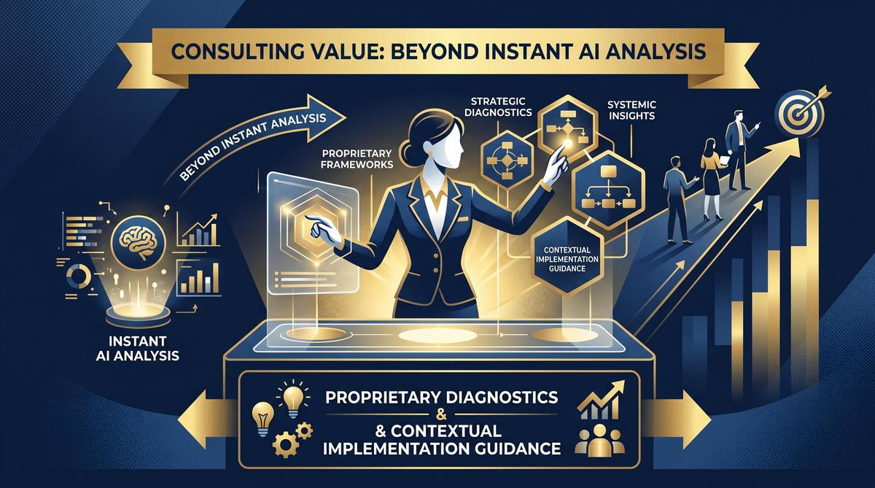
The democratization of artificial intelligence has created a paradox in the consulting industry. Sophisticated analytical tools now generate insights in seconds that once required teams of analysts and weeks of effort. Business leaders can access competitive intelligence, market forecasts, and operational diagnostics through platforms that cost a fraction of traditional consulting engagements. Yet the demand for experienced consultants persists, and in many sectors, it grows stronger. Understanding this dynamic reveals where genuine advisory value resides in an algorithmically augmented marketplace.
AI excels at pattern recognition within defined datasets. Feed a machine learning model clean historical sales data, and it produces forecasting models of remarkable accuracy. Provide natural language processing tools with customer feedback transcripts, and they extract sentiment trends, emerging complaints, and satisfaction drivers. These capabilities have commoditized the diagnostic phase of consulting engagements. What artificial intelligence cannot reliably deliver is contextual judgment—the synthesis of organizational culture, market positioning, competitive dynamics, and stakeholder motivations that shapes whether an analytically optimal strategy succeeds in practice.
Consider a manufacturing client facing declining market share. AI analysis might identify pricing discrepancies, distribution gaps, and product feature deficiencies. The recommendation to lower prices and expand channel coverage appears mathematically sound. An experienced consultant, however, recognizes that the client’s brand equity rests on premium positioning, that their distributor relationships operate on trust-based exclusivity agreements, and that recent quality investments justify premium pricing if communicated effectively. The human advisor reframes the challenge from price competitiveness to value communication—a fundamentally different strategic path.
The role of contemporary consultants increasingly resembles that of skilled translators. They bridge the gap between algorithmic output and organizational reality, interpreting AI-generated recommendations through lenses of feasibility, cultural fit, and implementation risk. The consultant who presents raw analytical findings without this contextual framing provides little value above what the client’s own AI tools deliver. The consultant who asks questions the algorithm cannot formulate—about unspoken stakeholder concerns, legacy system constraints, or emerging regulatory shifts—commands premium engagement rates.
Implementation support represents another irreplaceable human contribution. AI can design theoretically optimal organizational structures, yet restructuring fails without change management expertise. The technology recommends process improvements, but adoption depends on behavioral modification that machines cannot directly influence. Consultants who combine analytical fluency with implementation discipline offer hybrid value that pure technology or pure advisory cannot replicate.
For organizations operating across linguistic and cultural boundaries, the challenge intensifies. Insights generated by AI in one market context may prove irrelevant or counterproductive in another. Resources like https://beautyofgames.com/swiss-multilingual-seo-language-regions.php demonstrate how specialized expertise navigates the intersection of technology and regional nuance—applying systematic approaches while respecting local particularities that algorithms often overlook.
The consulting profession will not shrink; it will bifurcate. Transactional analytical work migrates to AI platforms, while high-value advisory engagements expand. Consultants who resist developing technical fluency alongside domain expertise face obsolescence. Those who master the human-algorithm partnership—using AI to accelerate insight generation while applying irreplaceable judgment to strategy formulation and implementation—define the profession’s future.
Key Takeaways: - AI commoditizes diagnostic analysis but cannot replicate contextual judgment and organizational wisdom - Consultants serve as translators between algorithmic insights and implementation reality - Implementation support and change management remain distinctly human competencies - The consulting profession bifurcates into transactional AI-mediated services and premium advisory relationships
Resources: - https://beautyofgames.com/swiss-multilingual-seo-language-regions.php